Dry sauna
Custom dry sauna cabins for houses across Malang
From a snug corner for two to a family room for eight, each cabin is measured and cut to fit the space you actually have.
A dry cabin holds 70–90 °C at 10–20 per cent humidity, built in cedar, spruce or thermowood around an imported Harvia heater. We fit them into houses across Araya, Ijen, Tidar and Permata Jingga, from two seats up to eight. As a guide: IDR 60–120 million for a 2×2 m cabin, on site 2–4 weeks after the free survey.
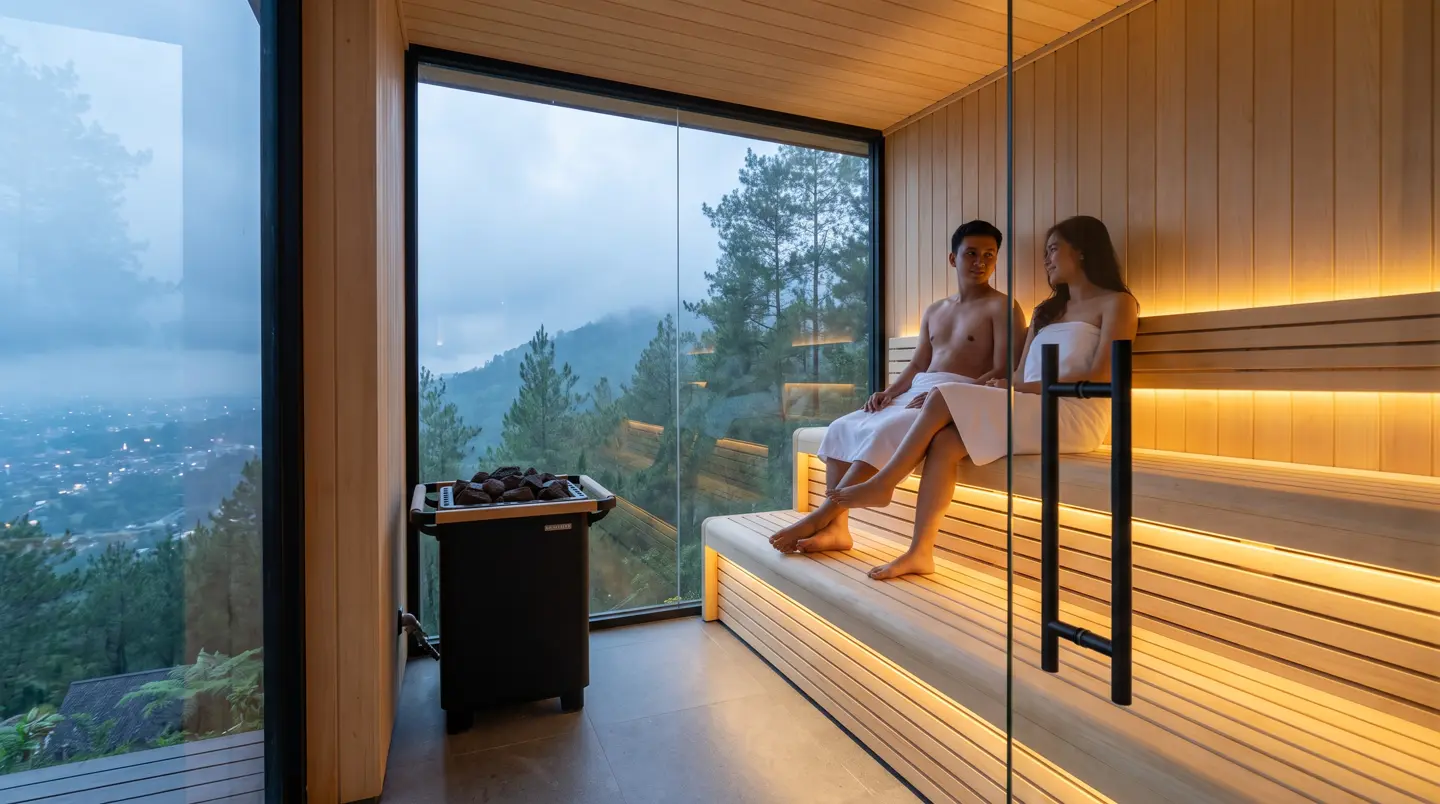
Why a dry cabin is usually the first thing people ask about here
The climate does a lot of the selling for us. Nights settle at 18–24 °C, the bediding stretch drags Sukun and Lowokwaru down toward 15 °C, and Karangploso mornings in August can open at 10–12 °C. Fifteen minutes at 80 °C before bed has a different effect here than it would in Surabaya, and stepping out into cool air afterwards rounds the whole thing off instead of undoing it.
The practical case is just as strong. There is no waterproofing, no floor fall and no tiling to plan around, so the cabin can sit in a spare room, a garage bay or the end of a terrace without touching the drainage at all. A four-person 2×2 m cabin takes up less floor than a double bed would. Two bench levels are standard — a cooler lower tier around 45 °C for children and older users, the real heat up top. Families chasing the full contrast routine usually bolt on a cold plunge once the cabin has proved itself.
Size follows how the room actually gets used. Two seats at 1.5×1.2 m suits a couple in a Tidar townhouse, 2×2 m covers most families, and 2.4×2 m at eight kilowatts fits a Permata Jingga household that hosts weekend guests. Given the choice, we would rather fit the smaller cabin that gets used every week than the bigger one that gets fired up twice a year.
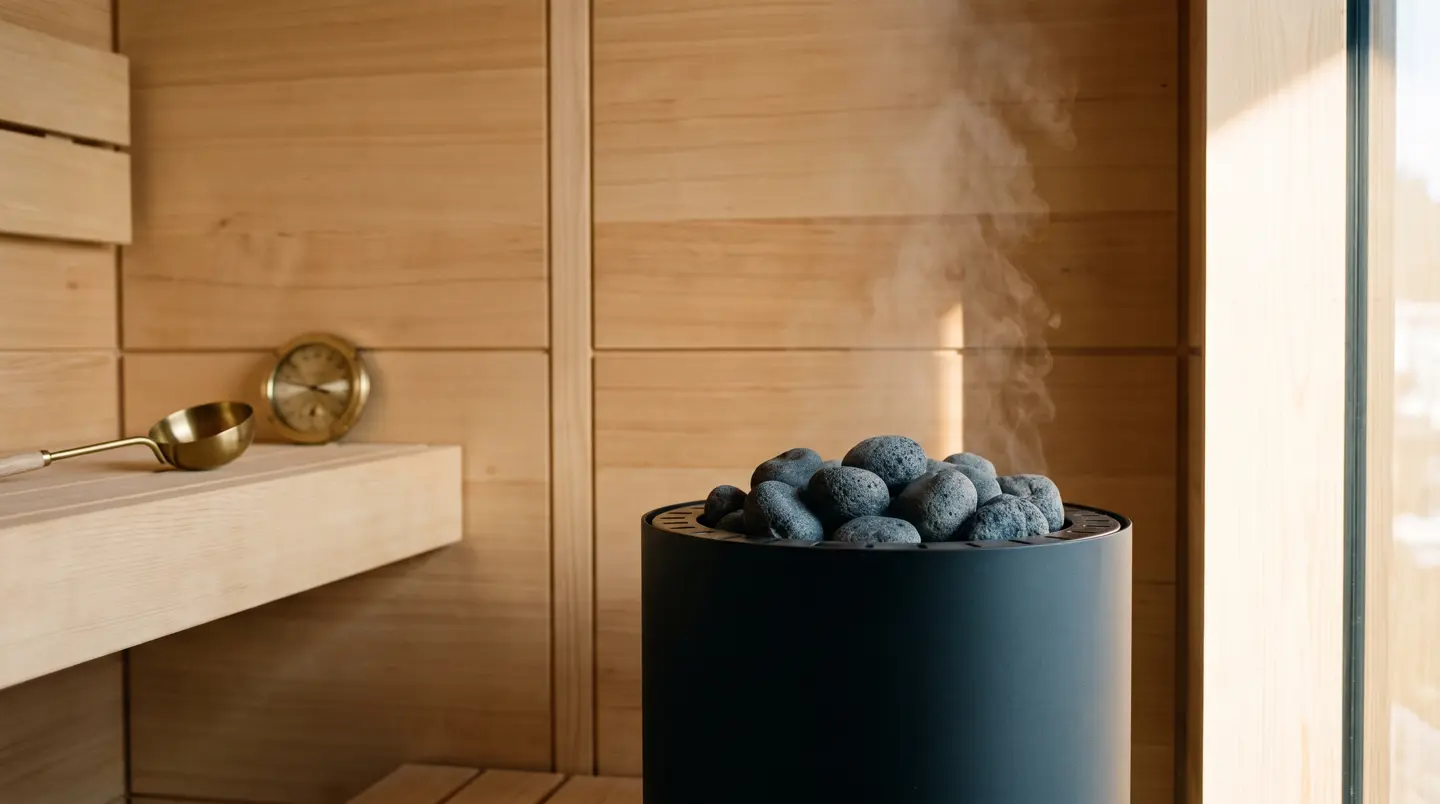
Fitting a dry cabin into an older Ijen house
Carefully, and always from the inside out. The colonial houses along Jalan Besar Ijen and through Klojen carry ceilings of three to four metres — lovely to look at, hopeless to heat. So the cabin becomes a room within the room: an insulated box at 2.1 m internal height, standing on its own frame, never touching the original plaster.
That protects the house every bit as much as it does the sauna. Nothing gets chased into old brickwork, no mouldings are touched, and the cabin can be taken apart and moved out if the property ever changes hands. The wall build-up is our usual five layers — panel, 50 mm rockwool, an aluminium foil vapour barrier, a 20 mm ventilation gap, cedar or thermowood — and ventilation runs to an opening that already exists rather than a fresh hole in a heritage façade.
Timber choice carries more weight in an older house, since the floor is rarely dead flat and the air tends to be damper. Thermowood barely moves with either problem, cedar shrugs off rot, and benches stay in aspen or abachi. Ulin and bengkirai are kept for decking outdoors, not the cabin itself.
What the heater actually needs from your electricity supply
We size the heater to the cabin first, then the supply to the heater — in that order, never the other way round. A two-seat cabin runs on 3.6 kW and around 5,500 VA. A four-seat 2×2 m cabin takes 6 kW on 7,700 VA. Six- and eight-seat cabins at 8–9 kW call for 11,000 VA, and anything past ten people moves to three-phase.
New clusters in Araya, Blimbing and Permata Jingga usually already sit at 5,500–7,700 VA, so the job is simply a dedicated circuit. Older houses in Klojen and around Ijen are often still on 2,200–4,400 VA and need a PLN capacity change first — the application goes in ahead of fabrication, the owner covers the fee, and we show that figure before anything is signed. Where an upgrade genuinely is not practical, an infrared cabin at 1.7–2.4 kW is the honest alternative.
Every cabin we hand over has SiHF cable running back to the consumer unit, its own breaker, an ELCB, a guard around the heater, and a firing test done with you standing there. For a family using it regularly, budget IDR 200,000–500,000 a month; the full range sits on the price page.
What a dry cabin costs
| Build | Guide price (IDR) |
|---|---|
| Two seats, 1.5×1.2 m, pinewood, 3.6 kW on 5,500 VA | IDR 55–70 million |
| Four seats, 2×2 m, red cedar, 6 kW on 7,700 VA | IDR 75–95 million |
| Custom 2×2 m cabin, up to four, any spec | IDR 60–120 million |
| Six seats, 2.4×2 m, thermowood, 8 kW on 11,000 VA | IDR 110–150 million |
| Eight seats, 3×2.4 m, 9 kW on 11,000 VA | IDR 150–200 million |
| Lighter, mixed-material build | from IDR 40 million |
| Bringing an existing cabin back to life | IDR 15–50 million |
| Replacement Harvia heater, 6–9 kW, installed | IDR 15–35 million |
Guide prices in IDR, covering the heater, stones, SiHF cable, breaker, ELCB and the heat test itself. A PLN upgrade, where needed, is billed to the owner separately, and the firm number follows the free survey.
Frequently asked questions
How quickly does a cabin warm up on a cold Malang evening?
From a cold start, a well-built 2×2 m cabin reaches 80 °C in roughly thirty to forty minutes, quicker once the room has already warmed through once that day. On the coldest bediding nights we sometimes size the heater up slightly so the climb does not drag — worth raising at the survey if you plan to use it late.
Does the cool climate affect how long a cabin lasts?
If anything it helps. With the vapour barrier and ventilation gap in place, a cabin here easily passes fifteen years, since Malang runs drier than the coast. Skip either layer and mould turns up within three rainy seasons regardless of the timber grade.
Can a cabin go on an upper floor?
Yes. A 2×2 m cabin weighs less than a full bookcase wall and spreads that weight across the whole slab. At the survey we check the slab, the staircase and the door openings before confirming.
How long from deposit to first use?
One to two weeks of fabrication and supply, then two to four weeks on site. Straightforward jobs inside Kota Malang often land at the shorter end; Batu and Lawang add a day or two for travel.
Can a plunge tub go in at the same time?
It usually costs less to do both together — one visit, one electrical route, one drain. A cold plunge with its own chiller runs an indicative IDR 45–90 million; talk it through on the contact page.
Where this covers
More builds
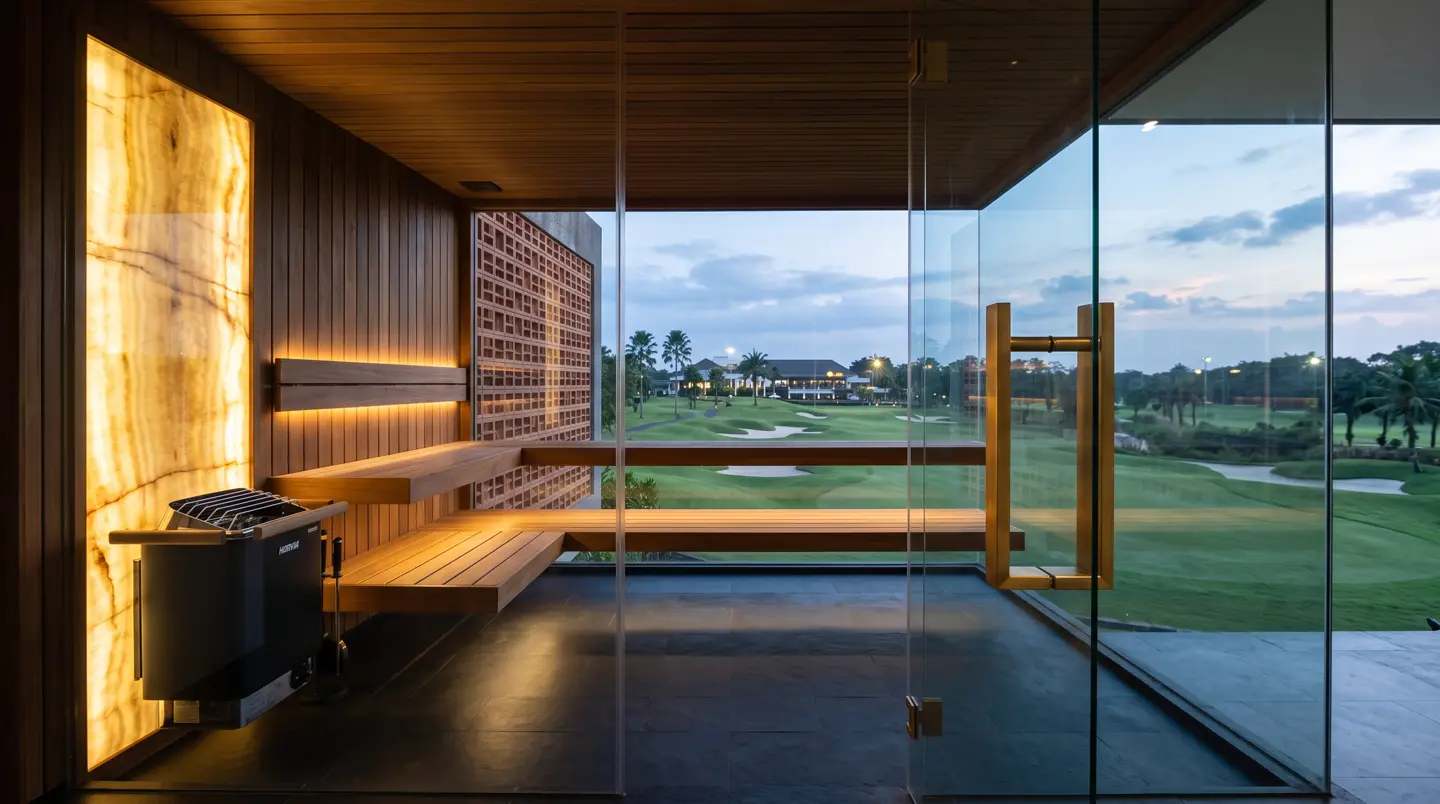
Villa & outdoor sauna
A roofed timber cabin for the terrace, built so a Batu stay photographs like somewhere worth booking again.
IDR 80–150 million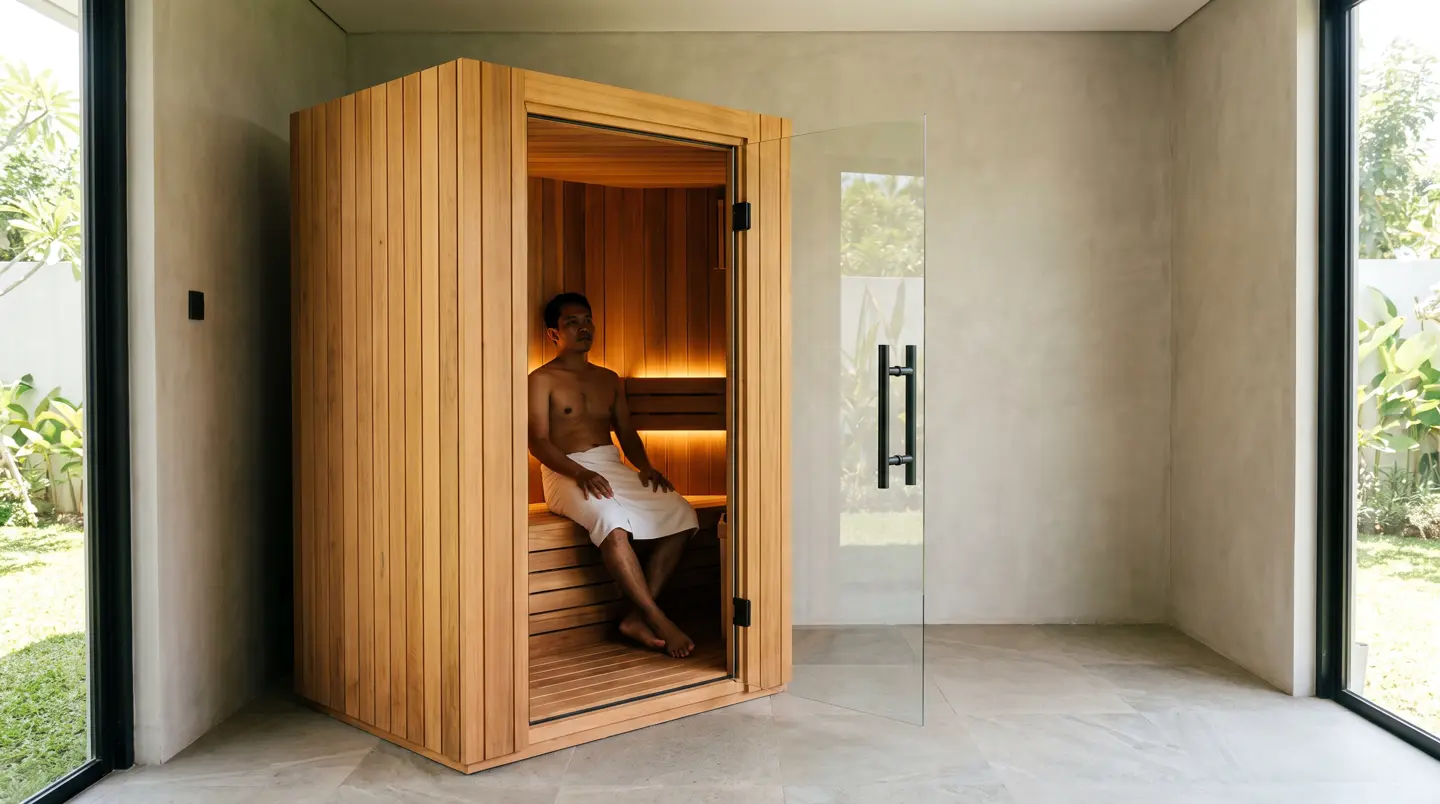
Prefab sauna
Panels that bolt together in a day and hold heat by evening — built for compact houses and homestays.
IDR 15–35 million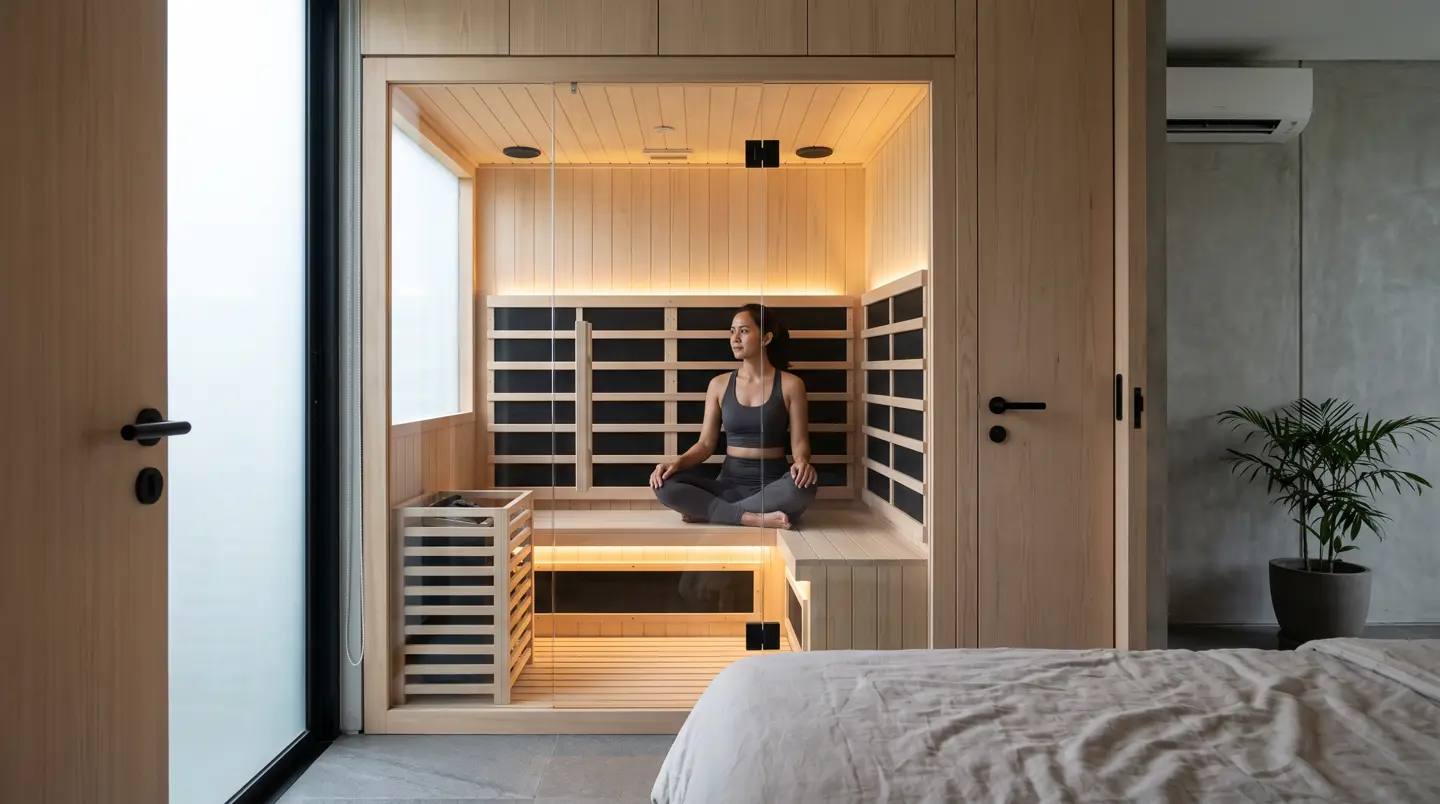
Infrared sauna
Carbon panels at 45–60 °C on an everyday socket, warm enough to use inside ten minutes.
IDR 30–45 millionGet a figure
Tell us about the room, we will tell you the number
Share your location and what you have in mind, and expect a call the same working day — then a free measure-up in Kota Malang, Batu, Dau, Karangploso or Lawang.
Three photos is all it takes to start
The room or terrace, the PLN meter, and the district you are in — send those over WhatsApp and a ballpark figure comes back before anyone gets in the van.